
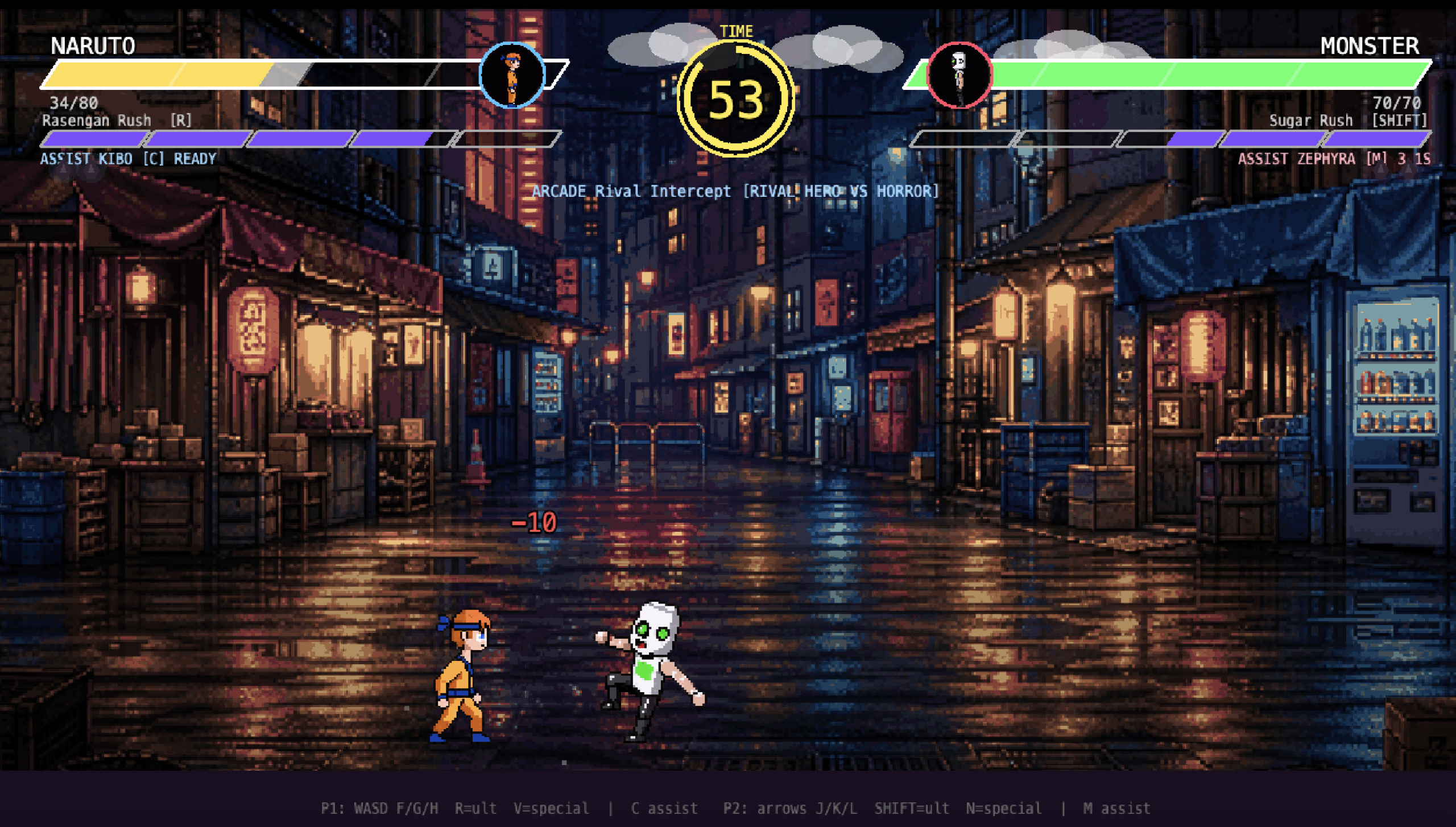
What happens when you put 2Pac, Naruto, Batman and a lecturer from The Hague University of Applied Sciences in a virtual arena? An absurd, nostalgic arcade experience and the ultimate answer to the question: how far can you get when you build a game entirely with artificial intelligence?
Innovative Development students Jessy Roest and Sohaib Khelanji put it to the test at GameLab. Guided by Jeroen Derwort, they embarked on a groundbreaking experiment: a 5-day sprint to build a functional 2D browser fighter from scratch. The catch? They could not write a single line of code or draw a single pixel themselves.
The result is an impressive game showing that game development for this type of game is changing radically. The sprint also exposed exactly where AI reaches its limits and why human input remains essential.
The concept: "Anyone vs Anyone"
The premise of the game, called Crossover Fighter, is as simple as it is ingenious: a browser-based arcade fighter in which any imaginable character can appear. Rather than focusing on highly complex fighting mechanics, the game relies on the sheer absurdity of its playable characters.
The students followed three principles to keep things moving:
- Working > looking good on paper: every day had to end with a playable version.
- Speed > perfection: 'good enough' is the standard. No hours wasted manually polishing AI mistakes.
- Data-driven architecture: adding a new character must never change the code. The engine simply reads a JSON file and its accompanying sprite sheet.
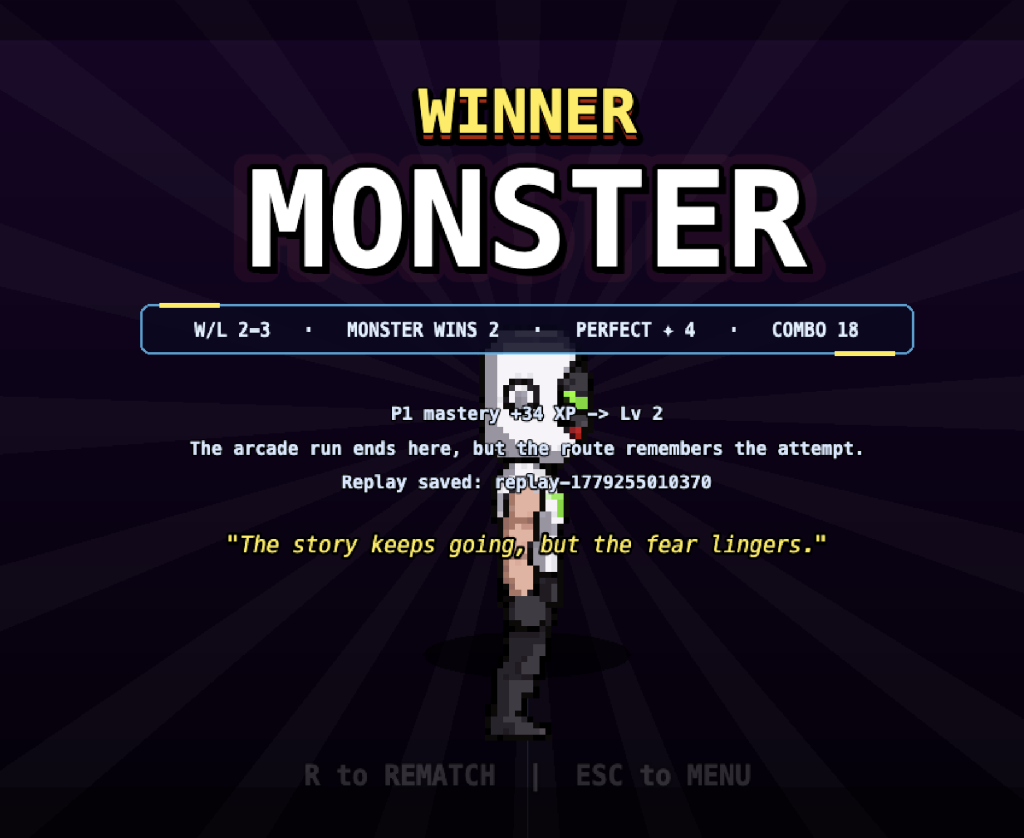
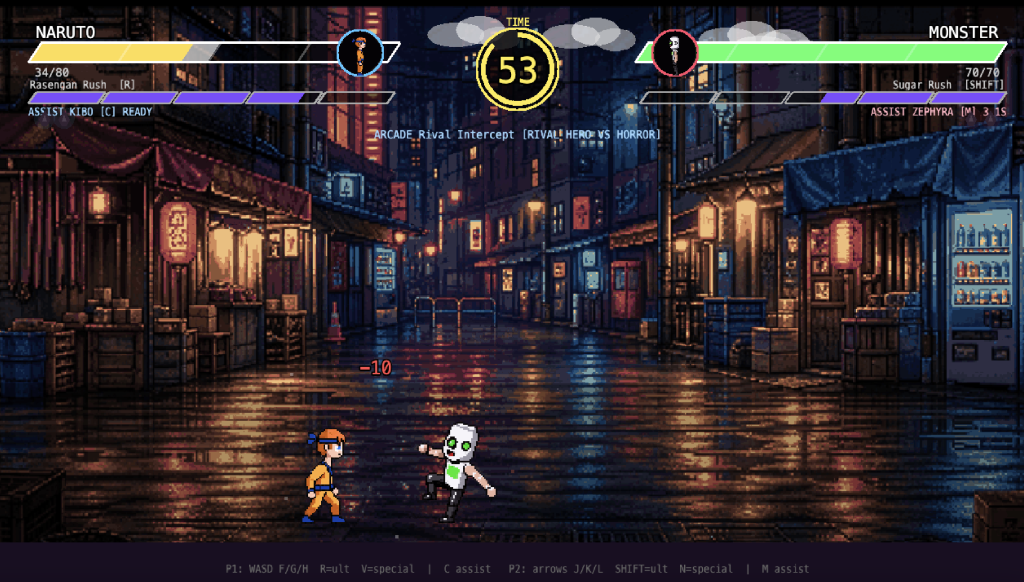
Human input: the game developer as conductor
Although not a single line of code was typed manually, this game is certainly no push-button product. Human input was the crucial factor in its success. Jessy and Sohaib transformed from traditional implementers into conductors. Their main responsibilities included:
- Taste and direction: AI has no understanding of humour, irony or coherence. The students set the artistic direction, approved or rejected output, and kept a close eye on visual consistency.
- Designing the architecture: Claude may have generated the code, but the students had to determine the logic in advance. They devised the data-driven structure, designed the fighters' state machine and decided as early as day 2 to insist on a visual hitbox debugger to avoid programming blindly.
- Guardrails and discipline: 100% AI without strict rules guarantees a creative explosion. The students set firm limits: no more than 3 attempts at a sprite sheet and no more than 5 attempts at an AI bug fix. Still not solved? The feature was immediately simplified or dropped.
AI's hard limits: the limitations
The final result is very impressive, but during the week the students encountered clear limits in current AI technology:
1. The "Stack Overflow trap" (plausible nonsense)
The biggest technical challenge was not that AI made mistakes, but that the coding AI produced "plausible-looking nonsense" with tremendous confidence. It wrote code that looked perfect at first glance, but simply did not work in practice or contained hidden bugs. Without immediate live testing and human reasoning to rein in the AI, the codebase would have become unusable within a day.
2. Inconsistency and the 'collage effect'
When generating graphics, AI struggled with continuity. Individual animation frames, such as walking or punching, looked good on their own but soon formed a messy collage rather than a single smoothly animated character. The students had to solve this by imposing a very specific, custom-trained style model (LoRA) on every character and accepting that "a hand looking a little odd in frame 3" had to be good enough.
3. The AI debugging deadlock
Sometimes the AI became trapped in a vicious circle: fixing bug A caused bug B, and fixing bug B brought back bug A. To break this deadlock, the students adopted a dual-AI policy: having ChatGPT or Gemini review Claude's code. Different AI models spot different errors, but a human ultimately had to make the decision.
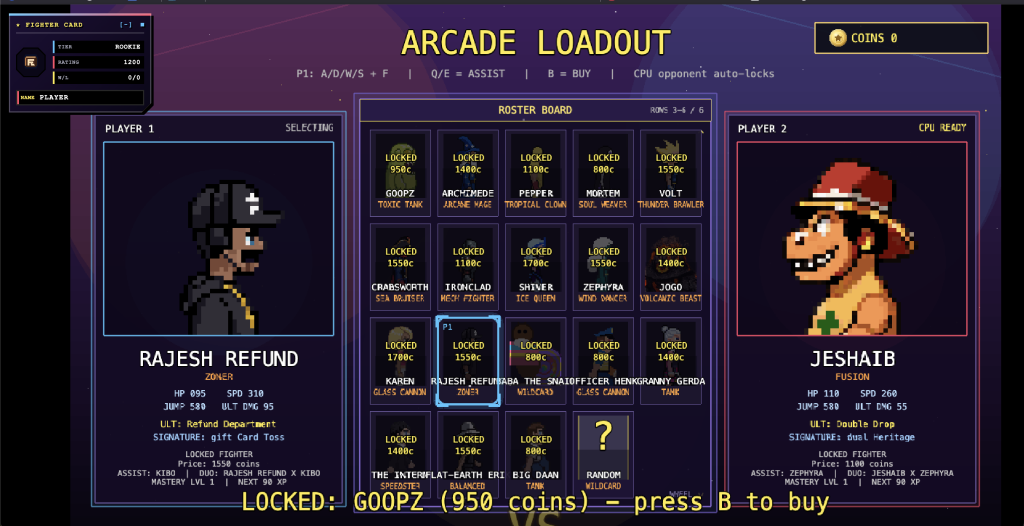
The roster and their 'ults'
Thanks to human direction of the asymmetric gameplay, every character still feels unique, complete with their own Ultimate Move (finisher). The game features dozens of characters. Here are a few:
| Character | Play style | Unique Ultimate Move | Vibe & Reference |
| Naruto | Fast, low HP, high mobility | Rasengan Rush: Dash towards the opponent, dealing heavy energy-ball damage. | Anime spirit-bomb energy |
| 2Pac | All-rounder, balanced stats | Hit 'Em Up: A beat drop triggers 3 rapid strikes in time with the music. | West coast, beat-synced |
| Batman | Slow tank with strong defence | Lights Out: The screen goes black; Batman teleports in for a grapple hit. | Arkham-style stealth takedown |
| The Lecturer | Wildcard with unpredictable hitboxes | Fail!: Throws a red pen that stuns the opponent and displays an 'F' above their head. | Inside joke, guaranteed laughs |
K.O. for the sceptics? The final result
Despite the technological limits, what Jessy and Sohaib created in five days is groundbreaking. During the live demo, the game ran flawlessly in the browser. Players could play a complete match locally on one keyboard, or against a CPU, including advanced game-feel elements such as hit pause, knockback, screen shake and a working audio pipeline.
The greatest triumph is that the promised data-driven architecture really works. Without a single hand-drawn pixel or line of self-written code, they have produced an extensible game engine into which new characters can be loaded straight away.
There is also room for improvement: because the students focused mainly on building as many features as possible in as little time as possible, the game contains many bugs. Fixing them would still take a relatively large amount of time.
What we learn from this
This experiment has now been carried out several times at GameLab. Every six months, we see students getting considerably further than before.
It shows that AI already dramatically lowers the barrier to building simple games, but that fears of 'the computer completely replacing the game developer' remain unfounded for now. AI is an incredibly powerful, but sometimes blind, engine. Without a human driver to set the direction, design the systems and maintain discipline, the project will inevitably grind to a halt.
I would put it this way: the age of the game developer as a visionary conductor has arrived. Insert coin!
Want to play the game yourself? You can! Check out Crossover Fighter here.