Like The Hague University of Applied Sciences, Rotterdam University of Applied Sciences offers a game development minor with a similar structure. To see how our Rotterdam neighbours were doing, I travelled into the heart of the city for a proper launch party organised by the students themselves.
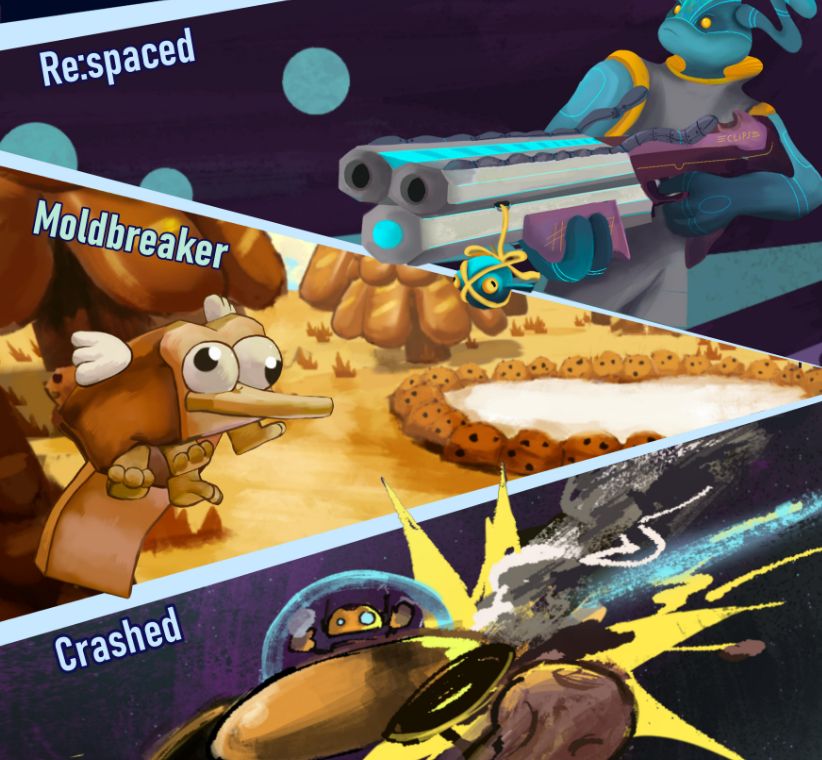
Three games were delivered at the end of this period: Moldbreaker, RE:Spaced and Crashed. Each was made by a student team. Although there were 'only' three, I was impressed by their quality. When I asked about the structure of the game development minor, it turned out to share many features with the approach in Zoetermeer, while also having interesting differences. Let me briefly list them.
One clear similarity is that neither university offers a complete games degree programme. RUAS does not even have a graduation specialisation or a GameLab, as The Hague does. Nor does Rotterdam have the resources with which HKU or BUAS shape their programmes. Capacity is limited, and that influences choices. But, as is often the case, limited resources also encourage creativity.
Another similarity is admission: anyone from the degree programme can join, as can students from other universities of applied sciences. This creates highly diverse multidisciplinary teams. Both minors last one semester, approximately six months. They combine courses and projects that students must complete in teams.
A brief comparison of the two Game Development minors.
The Hague University of Applied Sciences
Group size
8–10 students
Game engine
Godot
Project
One game of the group's own choosing, which the team starts immediately
Interim evaluation
2 playtests in which lecturers and teams test the games and give feedback
Final assessment
Courses and individual assessment within the project. A prize for the best game at the Expo, decided by a professional jury.
Rotterdam University of Applied Sciences
Group size
20 students
Game engine
Unity
Project
Small mobile game in the first 6 weeks
Larger PC game for the rest of the semester
Interim evaluation
A 'Dragons' Den' session halfway through, at which games industry experts are asked to give feedback on the games
Final assessment
Courses +
First game: at least 100 downloads
Second game: at least 900 downloads
Beyond these differences, it is striking that Rotterdam University of Applied Sciences pays no attention to narrative in its courses, whereas this is an important element at The Hague. Rotterdam does, however, focus on marketing, which receives less attention in Zoetermeer.
I do not think either approach to education is better or worse, as the resulting games differ relatively little in quality, particularly when the different team sizes are considered. Both programmes have their own strengths and weaknesses.
What I find interesting about Rotterdam's approach is its focus on the games' popularity. Requiring students to publish their games on Steam and in the app stores, and to achieve a certain number of downloads, encourages them to think seriously about a target audience and how to reach it.
At The Hague University of Applied Sciences, we do have GameLab and the graduation track, where students can continue with game development after the minor. Rotterdam University of Applied Sciences has no equivalent, so the teams generally stop after the minor.
With one major exception: the highly successful Total Mayhem Games. That group of students founded a new studio with lecturers when their game, "We Were Here", became a hit. The Hague University of Applied Sciences is still waiting for a flagship success like that. But we are working hard towards it.