GameLab students build wonderful games, but how do you make sure the whole world really understands them? Hint: it takes more than running your game through Google Translate or ChatGPT.
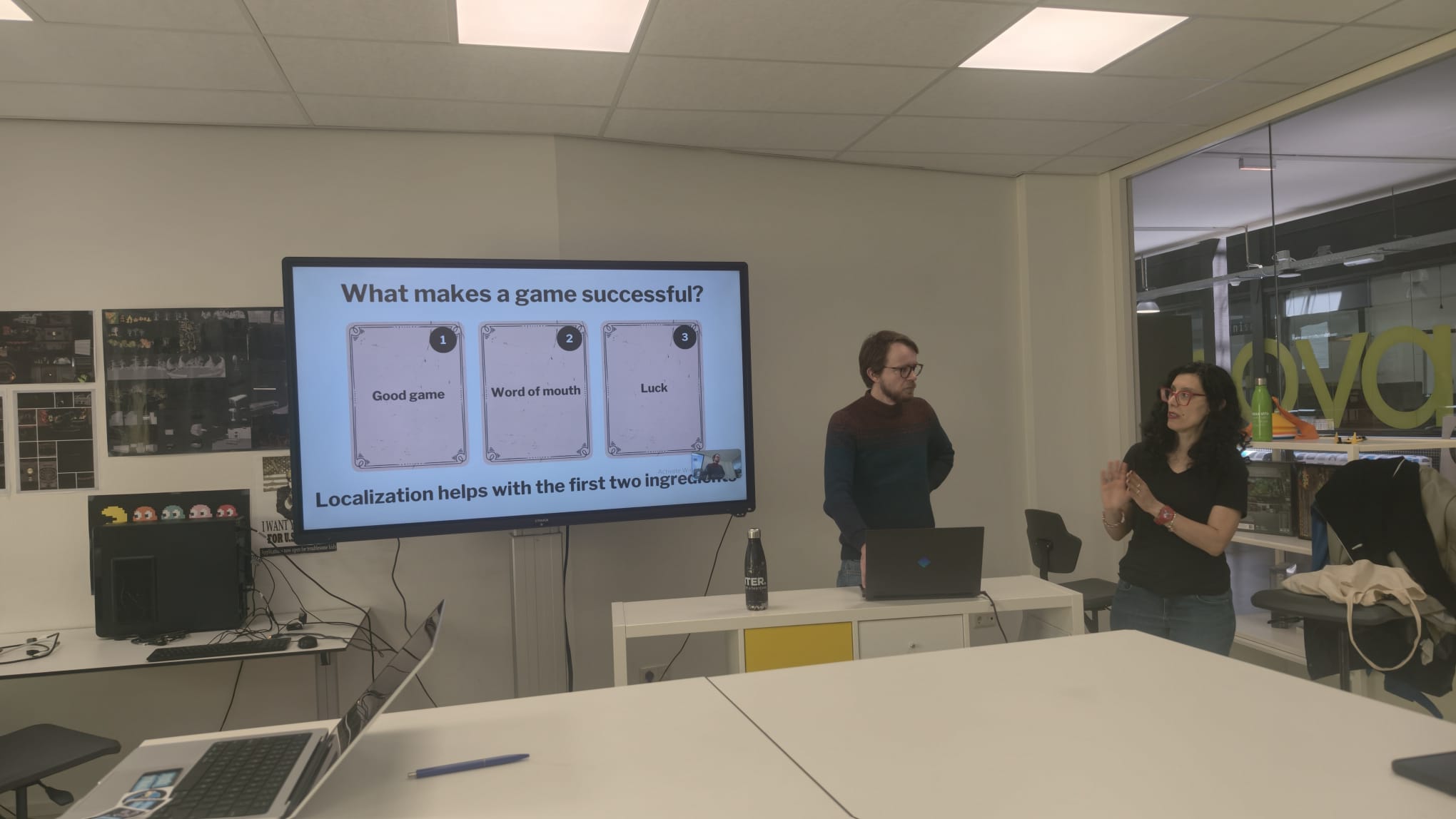
Last week, our students received an exclusive masterclass from two leading industry experts: Christian Hoffmann, a German localisation specialist, and Elena Zaffaroni, an Italian localisation specialist, from Charon Translations / localizeit. It was an afternoon full of eye-opening insights into the invisible art of game localisation.
Culture rather than code
In the lecture, Christian and Elena explained that translation converts words, while localisation conveys an experience.
A joke that works in Dutch can fall completely flat in German. A bloody combat symbol considered cool in Europe might lead to an age-rating refusal in Asia. Our students learnt that getting localisation right means including it early in the design process. If you still have to change culture-specific jokes, interfaces or fonts afterwards, you are often too late, and it costs a fortune.
"Localisation is only truly successful when players think the game was originally written in their own language."
UI/UX: the developer's nightmare
One of the most practical lessons concerned the interface. Using some hilarious and painful examples, Christian showed how languages differ in length.
- The rule of thumb: German and Italian often require 30% more space than English.
- The consequence: if you design UI buttons tightly around English text, your entire layout breaks as soon as Christian or Elena gets to work. A simple word such as "undo" becomes "Ongedaan maken" in Dutch. That is ten more letters than the original.
Our students received a crucial tip: always design with text expansion in mind.
How do you work with translators?
Many beginning developers simply send a translator an Excel sheet containing isolated words. Christian and Elena explained why that is a recipe for disaster. Without context, translators do not know what they are working with.
Involve your localisation team in the process through the following steps:
- Provide context: Is the word 'Run' a verb, meaning to run, or a noun, meaning a playthrough?
- Create a lore bible: Keep character, weapon and location names consistent.
- Send visual material: Screenshots and videos help translators understand the game's tone and atmosphere.
The future is global
Thanks to Christian and Elena's inspiring stories and practical examples, GameLab students now see their projects in a completely new light. Games are universal, but the experience is local.
At the end of the lecture, an interesting discussion arose about using AI for translation. Christian and Elena explained that AI is now often used to reduce costs, but that this almost always comes at the expense of translation quality. The market is changing rapidly.
Christian and Elena, thank you so much for your expertise and passion! Tschüss and Grazie!