
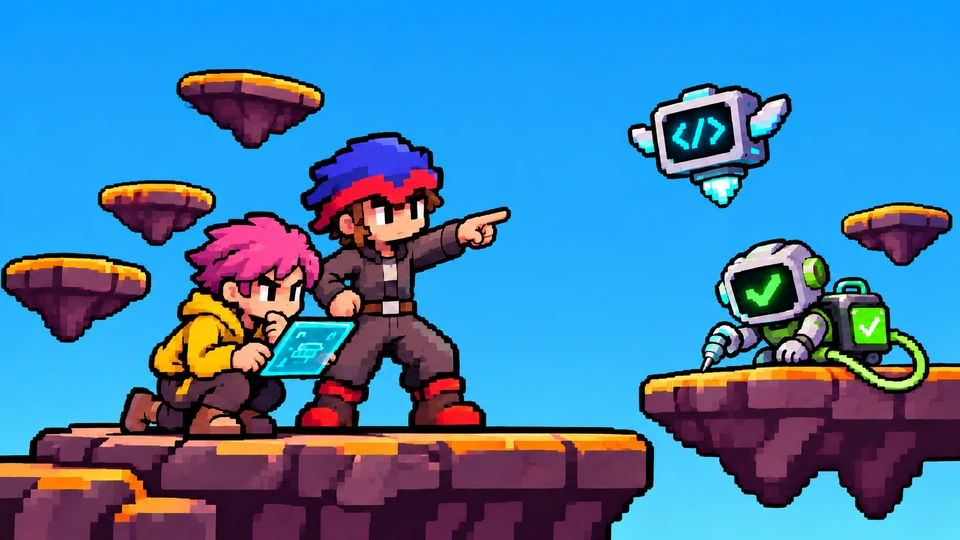
From February 2027, GameLab will stop supporting manual programming as the development workflow for game projects. We are moving to agentic engineering. Students decide what the game should do and direct a coding agent that writes, changes and helps test the code. The student remains responsible for what goes into the game.
What has changed since the summer
In July we wrote that students at GameLab could still choose to program their entire game by hand. We already saw AI literacy as important and recognised that some projects needed AI to deliver something in the time available. We also stressed that you should be able to understand and debug the code. Read what we wrote in July.
The summer of 2026 was the turning point for us. Large language models have improved to the point where coding agents can take on most of the code writing in our projects. They can navigate an existing project, make changes across files and act on feedback from tests. For us, that has made the transition unavoidable. Building games increasingly means spending time defining the problem, structuring the code and assessing the result.
What agentic engineering looks like
Pragma-Code describes how David Heinemeier Hansson, the creator of Ruby on Rails, delegates code writing to agents and takes responsibility for architecture and quality as a developer. At GameLab, that means giving an agent a clearly defined task, reading the proposed changes and checking for yourself that the game behaves as intended. Reading, testing and debugging code are still part of the craft. Read Pragma-Code’s analysis of agentic engineering.
Take a checkpoint in a platform game. Start by describing what should happen when a player reaches a checkpoint and then dies. Ask the agent to inspect the existing respawn system and propose a small change. Review the files it changed and play the level yourself, including what happens when the player dies before reaching the first checkpoint. That way, you can explain why the change works and know where to look if something goes wrong.
Working with agents in Unity, Godot and Unreal
Agentic engineering fits well with how these engines are used. An agent can, for example, change a C# script in Unity, review a GDScript in Godot or extend a C++ module in Unreal. Give the agent access to the project files and the available build or test commands so it can make changes and act on feedback from the engine. Then check in the editor that the scene and gameplay behave as you intended. See the command-line documentation for Unity, Godot and Unreal Engine.
Preparing for work in the games industry
We expect game studios increasingly to ask junior developers to work with coding agents. In our view, relying on manual programming alone will soon make it very difficult to find work in game development. Use your time as a student to practise defining tasks, reviewing changes and testing. In your portfolio, show the decisions you made, what the agent did and how you checked the result.
Getting started without a paid subscription
Many students have had little experience with this so far. Access is part of the reason. A subscription for Claude Code or higher usage of Codex costs money, and free access can come with usage limits. Codex is also available on the free ChatGPT plan. See the details for Claude Code and Codex.
Freebuff is a free alternative for practising. You can use the coding agent in your terminal or through a desktop app, among other options. The free service is funded by advertising, and usage allowances can vary by country. Start with a small practice project and ask the agent to explain an existing feature. Then pick one change you can check yourself. Try Freebuff or read how free access works.
It is understandable to feel uncertain about this shift, especially if you have just learnt to program by hand or have never worked with an agent. Your knowledge of code helps you ask good questions, spot mistakes and understand the result. At GameLab, you can begin with one small task and talk through your first attempt with your supervisor. Get in touch if you have questions about the transition.
Art and creative decisions stay with the makers
The new workflow applies to programming. In art, music, storytelling and game design, AI can sometimes help explore ideas or try variations. The makers decide on the style, judge what fits the game and take responsibility for those decisions. Taste and creative direction remain human work.